Categories
Learning Life

Confronting Mental Health: A Trip to a Mental Health Hospital

We should make it clear that getting help isn’t a sign of weakness — it’s a sign of strength.” – Michelle Obama

I have always struggled with mental health. My first bout of poor mental health was at age six. I did not comprehend why I felt tearful or had a heavy feeling in my chest for weeks. I just knew I wanted to end my life. This depression continued for years, and my family refused to help me. I suffered alone. I became very ill at university but managed to formally get a diagnosis of multiple mental health problems: depression, social anxiety, general anxiety and borderline personality disorder (BPD).

Finally, I had a weight taken off. I was not going crazy – I had conditions that were and still are very valid. A formal diagnosis allowed me to seek help from doctors, start a course of medication and learn more about my cognitive behaviour. These diagnoses happened two and a half years ago.

In early October, my I decided to be a tourist and explore the suburbs of south London. Armed with Google Maps and very little money, I hopped on the bus and headed towards Bethlem Mental Health Hospital, London. I had no idea what to expect. The grounds are pleasant in the autumn sun. It was peaceful. Yet, I felt a little uneasy walking through the main entrance onto the grounds. I was not sure why. I dropped the thought and wandered toward the gallery. Inside, the reception looked like any other gallery with an exhibition.

Except, this the work was from a patient and demonstrated their observations from their time there. It was their form of therapy. From the interior of their room to cutlery, there was comfort in seeing how everyday items become art subjects. Bethlem Hospital has done incredible work with patients and has helped a few people gain art grants to support their work. However, going up the main staircase is where my uneasiness deepened. I came face to face with the statues Raving Madness and Melancholy Madness. Created by Caius Gabriel Cibber, they once adorned the entrance gates of the hospital’s second home in Moorfields, marking a dark time in mental health treatment.

Their faces were worn; their soulless eyes and gaping mouths shook me. One is wearing shackles too. Is this really what people thoguht of others with mental health conditions? Whilst eye-opening, I cannot unsee those faces and what they represent. To call them Raving Madness and Melancholy Madness in this day and age made my blood boil. We cannot erase history, but they could have updated names, especially since they are within the grounds of a mental health hospital.

Upstairs, there lay a timeline of the history of Bethlem Mental Hospital around the stairs. I was comforted to see how this hospital has vastly improved conversations around mental health and Bethlem’s support for people in the latter half of the timeline. They are doing incredible work within the mental health field today. Yet, I cannot forget their compliance with the poor treatment of those in the past. This feeling only grew as I walked around the museum. Starting with stories from the modern day, I felt fine knowing those who told their story had received respect and support during their time at Bethlem. Their projected videos made me feel understood by those reciting their stories. From learning how they came to the realisation they needed support from professionals to having difficult conversations with family, I knew their feelings well.

Nevertheless, it was seeing a real-life record of patients from the 1800s that brought fear to me. I read a list of all female names. They were my age; twenty-three to twenty-four. They never left the institution.

Electro-shock therapy instruments, scalpels and an apothecary of Victorian-looking glasses lined the cabinets. From straight jackets to the padded walls, the museum became a fear come to life. How could someone be treated like this? It made me think of the pain they suffered and my guilt of being fortunate to live in a society where mental health issues are becoming less taboo. However, I feel disgusted to know that in some rare cases, people with severe depression may still receive electric shock therapy. I had many negative emotions, but I did not understand why until I read their mental health guide.

After analysing myself, I realised that despite appearing well, it is a facade. In particular, their section on grief and depression stood out. I had not properly grieved the loss of my grandmother last year. I have regrets, and I could not accept her death. I felt guilty for not visiting her at the hospital during the pandemic. It was this manifestation of my depression projected onto what I was seeing. I felt obliged to be angry on behalf of those names I read because it was easier to have this emotion than deal with my mental health issues. I felt vindicated to be mad because there was a lot of information on depression and schizophrenia but very little on other mental health problems. I was scared. Scared because I also have BPD; people will not understand.

Having BPD on top of other mental health problems made me feel like an outsider. On reflection, whilst there is not a section right now, that does not mean there will never be. Work by psychiatrists and staff at the hospital to improve the lives of those with the same condition or other mental health problems is incredible.

Bethlem has succeeded in supporting patients with complex mental health needs and is pioneering its approach to art therapy. They are working to keep mental health at the forefront of society and educating people of all ages about how we can make places safe spaces for those who need support. And most important of all, it is okay to not be okay.

If you or a loved one have been suffering with poor mental health, please reach out to The Samaritans on 116 123 if calling from a UK number. If from the US, you can reach the Suicide and Crisis Lifeline on 988. For other country lines, please consult http://www.suicidestop.com

Categories
Travel

Down and Out in Oslo and Riga Part 1

‘Within certain limits, it is actually true that the less money you have, the less you worry.’ – George Orwell

As a student, I have little opportunity to see the world whilst studying and working. However, in April 2019 I was able to visit Oslo, Norway for 3 days for £120 and in January 2020, I was able to visit Riga, Latvia for £160 for 5 days. Admittedly, these countries may seem random and they sort of are… but they are easily one of the best places I have been in the short 21 years that I have been alive.

Word of warning, you may get some travel envy from the photos of Oslo and Riga – I apologise in advance!

Norwegian Fjords

Oslo, Norway – 2019

A little fun fact about my trip to Oslo that I always use for the awkward ice breakers that are inevitable at university or in a work situation – the return flight journey cost me only £2. Yes, £2! How? sign up for newsletters like Save The Student . The emails can be annoying, but they have people doing a lot of research so it saves you from wasting your time looking for deals. I saw ‘flights to Norway and Denmark for £2’ in their subject line and thought ‘eh, why not?’. I mean, I was curious to see if it was a scam but it was legitimate. The email took me to something similar to sky scanner and to get it for £2, it had to be during April and for a certain amount of time, but luckily it coincided with university holidays (thank god). To get it that cheap, I had to fly from Stansted in Essex, but that was chill – my parents were living about an hour from there.

I could have gone to Denmark since I have an obsession with Hans Christian Andersen, but chose Norway as I didn’t know a lot about the country and thought it was now or never. I also wanted to do something different with my then boyfriend (we broke up before the holiday, but that is a different story).

As the flights were out of the tourist period, we were able to book a hostel style place for £60 for 3 days, saving around £120 on accommodation and we would cook in our accommodation since eating out is EXPENSIVE! We found a grocery store that was around the corner from where we were staying, and it was pricey in comparison to what we are used to in the UK but still the cheaper option. We made pasta dishes and packed lunches to keep the cost low. However, we treated ourselves to a coffee when out every day and a pizza restaurant on our last night, so we did try stuff while out… including trying to drive electric scooters!

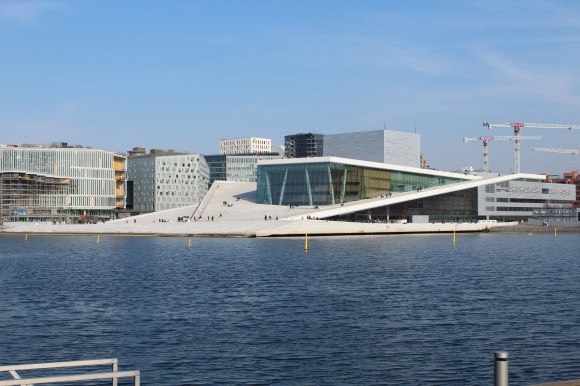
Oslo opera house

Each day, we walked over 7 miles since we wanted to explore the city. From our accommodation to the city, it was about 25 mins so it was doable. It was pretty cold during April so walking also kept us warm while we wondered across the city. We visited the opera house as it was free to enter and there was an exhibit going on. I know no Norwegian other than hei (hello) so reading about the costumes and set designs was an interesting exercise on how well I can use Google. What I managed to find was how important the opera is to Norwegian culture and how extravagant the work is that the team put together to ensure the shows are not to be missed.

Also, the opera house is the only one in the world in which people can climb all the way up to the top. Many young people use it as a ramp for bikes or to go up and down on with an electric scooter… we chose to walk it. When at the top, you can see miles around and watching the sunset from up there is truly beautiful. I recommend seeing this if you find yourself in Oslo at any point.

Admittedly, I know very little about Norway history outside the Vikings, but that did not stop us from looking around their forts and their army base to learn how important the army was in fighting Nazis in World War II. It was a history lesson that I wish we could learn about in schools since we tend to only focus on Britain, thus leaving out other nations’ contributions. Like many other Scandinavian countries, military service is mandatory for physically abled men and women from age 19-44, with a required service of at least 19 months.

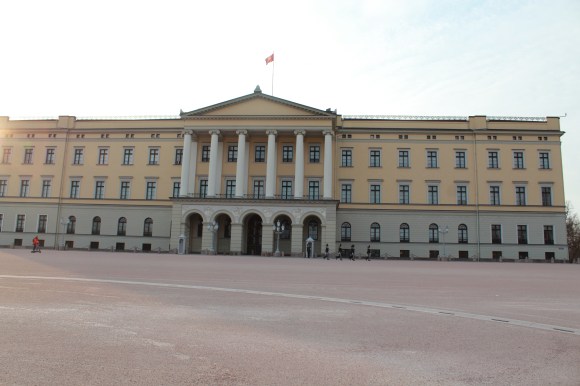
The royal palace

Strangely, people can walk right up to the royal palace doors – that’s not something you see every day. Although not as grand as Buckingham Palace, the fact that you can go up close to the palace illustrates how different this nation is to our own. The royal family are not as divisive as they are in the UK and seem relatively normal for who they are.

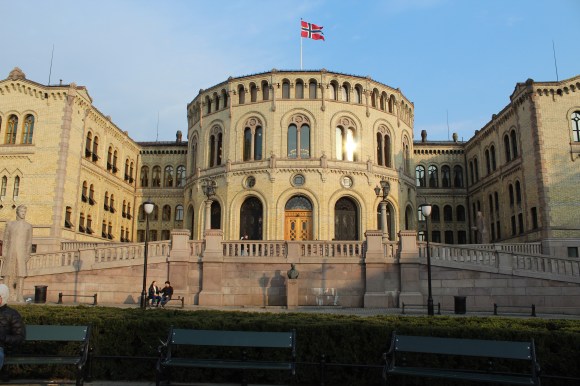
Norway’s parliament building

Likewise, you can waltz right up to the doors of parliament in Oslo without any security gate or guards suspiciously eyeing you up. Norway is considered a socialist country despite having a conservative government… which seems contradictory by British standards. However, we did witness a protest one lunchtime – there was mounted police, barricades and police on foot. With angry Norwegian chants, signs, speaker phones and middle fingers, we had no idea what it was about. It was all in Norwegian of course and I was too afraid to ask a police officer what it was about, so I turned to my trusty friend, Google. Turns out it was a youth group who was protesting for true socialism in Norway – from women’s rights to the homeless, they were demanding more of their government. While it was interesting, I did not feel like being arrested and so we moved on.

One comparison though – the UK goes BIG when we choose top protest. Maybe 150 people took part in this peaceful protest in Oslo, but we have thousands, if not millions who turn up in solidarity when the people of Britain want change.

Other activities included visiting the Viking museum that is out of town. Transport is expensive in Norway, but I guess that makes sense when it is free for all under 18s and all over 65s – but we had to take it to go and have an interactive history experience. For the equivalent of £8 (flash your student ID otherwise it is £10), you can enter the Viking museum and City museum for the whole day. Not bad when you want more bang for your buck! You have to store your bags in a locker outside in huts to ensure you don’t steal anything, so ensure you take your phone or camera with you if you visit. And don’t forget which locker is yours and your code… like I did, oops.

Norway's Viking Ships Defied Time, but Tourism May Be a Fiercer Foe - The  New York Times
Noe Falk Nielsen/NurPhoto, via Getty Images

Anyway, we had seen one of the eldest surviving Viking boat that is still in pretty good tact. They are huge – I didn’t realise just how big they were until I saw them with my own eyes! Most signs are in Norwegian, French, German and English so you can learn a lot about these warriors and their culture. One of the best things we saw was a light show that was projected above us that told the story of how they honoured the dead. Many warriors were buried in boats with treasures around them as they believed they would need them in their afterlife. Some were sailed out to sea and others were buried in mounts of earth. The story that was shown was quite emotional for me and was a beautiful telling of the Viking culture.

Once we were done looking at the boats, we went into the other part of the museum – where there were a lot of objects. Looking at objects may seem boring, but ‘reading’ the objects allows for onlookers to understand the Vikings’ way of life. From their mugs to housing tools to celebratory chairs, there was a lot to understand. There was a lot of gold encrusted items which I expected, but I also found it interesting on how advanced a lot of their tools were and their treatment of women. Women could be warriors and pretty independent!

The coolest thing though, was seeing what the Vikings believed to be Thor’s hammer. I love Norse mythology and all you Marvel Universe fans best believe it exists in real life. Sadly Thor isn’t real and I doubt if he was, he’d look like Chris Hemsworth either, but it is still cool to see the hammer!

The most peculiar thing though, is that although the Vikings came from Sweden, Iceland, Finland, Norway and Denmark but the Norwegians consider the Danish as the ‘savaged’ kinds. I don’t know how true this is, but it is interesting on how one’s country perceive their parts in atrocities and imperialism… even if it was thousands of years ago.

We also visited Neseblod Records, the birthplace of Norway’s black metal scene on the request of my ex. Although established in the early 90s, this scene is still big in Oslo and the city sees a lot of classic metal bands and artists such as Alice Cooper, Metallica and Black Sabbath. Although I compromised with him and spent 2 hours in the store, I got my own back. We went to lay flowers on Edvard Munch’s grave. For those who do not know, Much was a part of the expressionism and symbolism art movement and painted ‘The Scream’, ‘The Ill Child’ and ‘Madonna’ – to name just a few. As a lover of art, I thought it was only right to pay my respect to him whilst visiting Oslo.

This may have been over a year ago, but I would love to go back and advise you all to visit at least once in your life. I was lucky to have a great experience for cheap but you can also do so!

Design a site like this with WordPress.com
Get started