Talent you have naturally. Skill is only developed by hours and hours and hours of beating on your craft. – Will Smith
A lot has happened in the last few weeks. From taking on the academic president role of one of the schools alongside my volunteer role as the faculty rep, created and launched the 1st faculty news letter and bereavement, to running in (and losing) the students’ union president election. Admittedly, I have been under an incredible amount of stress during this time and had almost dropped out the race as it all began to take a toll on my mental health and degree. However, I persevered and I am proud to have done so. I made friends with candidates and proved that despite adversity, I can create some funny and creative posts.
I ran this election with only two people on my team, but I’m incredibly thankful for them. We were able to become closer and share creative ideas in a safe space – nobody thought any idea was ridiculous! From silly memes to cute animal pictures, we were going to make this campaign a nice one.
I previously won Vice President of Education and Democracy 2019/20 (you can read about it here) and Faculty Officer for Arts and Humanities 2020/21, but these campaigns were definitely not the best. Students love memes and I played up to that for the last two elections, but I wanted to step it up from there. I needed to market myself in a better way, but how?
I had researched a lot of other people’s campaigns in the past and had a look at some from other universities and went with it.
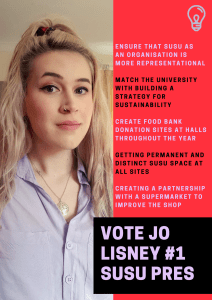
Main Manifesto Poster
I am most proud of how far along I have come regarding my graphic design work as I shudder at the thought of my VP Education and Democracy campaign. With that being said, I do stand by associating a colour with myself because it does make you stand out. I had turquoise tips for VP and made a lot of my campaign the same colour for that purpose; a technique I transferred over to the President campaign (this time it was lilac). I went with a calming colour this time around because I wanted to present myself that way to voters and hey, it is pretty!
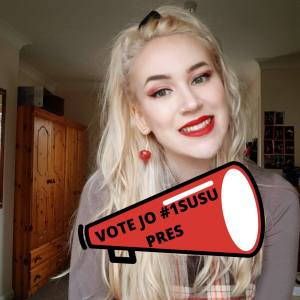
All Social Media Profile Photo
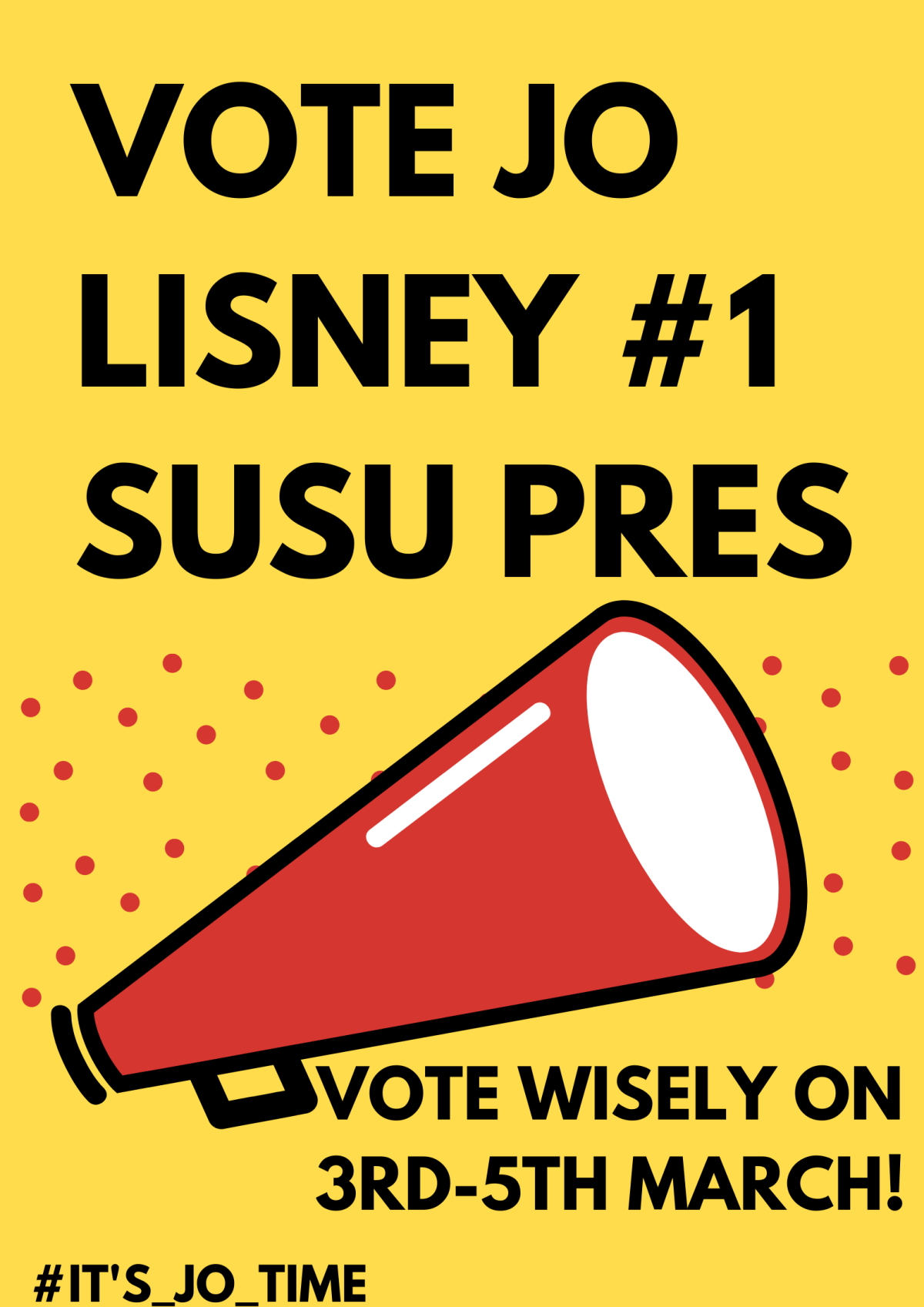
I decided I needed to switch things up to get information out there and sometimes simple works. That’s why I have the bright red speaker phone and yellow poster. I personally think the colours are ugly, but I know it works and having the speaker phone as a motif for my profile was an easy graphic to use that allowed people to connect the dots. I also love red so it goes well with my candidate photo which was the photo above, but without the speaker phone on. I tried to show people that I do have a fun side and that is why I don’t look that serious in the photo. Plus, I rarely smile with my teeth… so they should appreciate it.
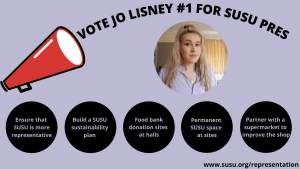
Simple Facebook Cover Image
As for social media, I plastered my cover photo and campaign photo everywhere I could. It was ‘in you face’ enough but not too annoying as I know that a lot of older students hate the election period. If they wanted to know more, they could look at the image or head to my page to find out more. Maybe I was a bit too relaxed, but when a lot is going on behind the scene, I’m glad to have placed 3rd.
Of course, I had some difficult questions asked to me but I expected nothing less. I went into this election with a realistic manifesto and I would answer all the questions that were thrown at me. I did not want to lie and give false promises or information because that is not me and hey, I would rather lose knowing I kept my honesty intact than lying about things that can never be achieved. I may not see eye to eye with my father, but he did instill in me that ‘there are people would rather vote for a politician that is honest than one that lies. They will unlikely win, but they gain a lot of respect.’ So, that’s what I did. I could not compromise on this and I am relieved to say that strangers have approached me to say they are proud of me for this effort.
Despite never imagining running for president two years ago, I am glad I took part instead of never doing it and wondering ‘what if’. I have refined my research and communication skills in the process as I connected with an array of university staff and students when building my manifesto. I feel closer to the student body now after researching their interests and concerns with sustainability, strategy, halls and sites. I may not have won, but I have gained enough knowledge that I look forward to bringing up in faculty meetings to help the staff direct attention in the right direction regarding my findings. The staff are keen to see what they can do outside that of academia to make students enjoy their time at university and I am happy to assist them where I can.
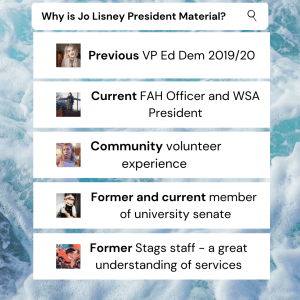
‘Why am I qualified?’ Search Poster
I am particularly proud of the ‘Why am I Qualified?’ poster as it satirizes the modern world that we live in, especially in a working from home setting. We constantly are looking for answers so I provided my in the context of presenting them as a search bar. Although a Google search appears differently, I wanted to show voters various photos as they can ‘paint a thousand words’. A lot of the time, students forget that there is a person behind it and will say horrid stuff about you, but I wanted to remind voters that I am human after all. You can Google my name and a full page will come up with stuff about me (all innocent, I promise!) but this poster aimed to save that search.
I am no graphic designer, nor did I ever claim to be… but this election has made me up my game in creating posters and graphics that I can transfer as I go into the place of work. I’ve gained confidence with various platforms to make these posters in and I no doubt will continue to play with them and develop even better skills. Maybe I’ll even get in on the animation!
Video Campaign Video Teaser Poster
I have never used TikTok but it is becoming a powerhouse as a way to market yourself. My team and I embraced the platform and created my campaign video! It was very cute – we had video of my friend’s puppy doing funny things and setting it up like the dog was explaining why you should vote for me. I could have done a normal video but let’s be honest, I will not be embarrassed if this appears years later when an employer searches my name! I shared the video on all of my social media (except LinkedIn) to make sure many saw the video and spread some joy because who hates a cute puppy?!
I may have lost this election, but I have won overall in experience.
‘All you need is Faith, Trust and a little Pixie Dust’ – Peter Pan
I started my Year in Employment in late June 2019 as VP Education and Democracy (VP Ed & Dem) at Southampton University Students’ Union (SUSU) and have been able to take opportunities that my course could not offer.
Diving in Deep to The Students’ Union World
Fundamentally, students’ unions exist to look after academic represent of the student body at university meetings and are a requirement by law as specified in the 1994 Education Act. Although my role does not have to exist by law, a VP Education and President must exist according to the university regulations. In 2018-19 there was a restructure at SUSU that reduced the number of sabbatical officers from 7 to 5 as voted for by the student body therefore leading to the creation on VP Ed & Dem.
Although I did not work in the University of Southampton, SUSU is a part of the experience and expectations of the Higher Education Sector. SUSU is an independent registered charity and business separate from the university. However, SUSU works closely with the university to ensure there is student representation on every level within the institution.
The main competitors for SUSU in this sector are closely related to University of Southampton competitors are the other student unions in the Russel Group ranking such as Exeter, Durham, Sheffield and Cardiff. Furthermore, the universities who are above Southampton in The Times and The Guardian university rankings are also their competitors. Whilst these rankings directly correlate to the university and ultimately are competitors, SUSU also have their own competitors that just relates to student unions and not the institutions associated with a union. For example, Portsmouth and Bournemouth students’ unions are their local competitors geographically, but also in the services they provide.
SUSU is a full-service union which means the union runs everything from sports clubs (competitive and non-competitive), societies, outlets (shop and bars), support and academic representation. In comparison, Portsmouth have moved away from full service to prioritise academic representation and have moved sports, societies, support and outlets over to the university to manage. Similarly, Bournemouth predominantly focus their efforts on academic representation. SUSU has not done so as their sports and societies outrank their local competitors as they are top 9 in the country for it. Likewise, SUSU believes that students come to university to get more than a degree and therefore they still operate as a full service.
The biggest challenges facing the Higher Education sector include: Brexit, increasing/decreasing tuition fees, instability of UK Universities minister changes in government, introduction of Teaching Excellence Framework at subject level, NSS Scores and policies from the Office For Students that affect the relationship and working of SUSU with the university. Of course, there are more issues that affect this sector, but these are currently what affects all the sector. TEF affects institutional reputation and has affected the amount of prospectus students applying to universities and the uncertainty of Brexit means EU students are put off studying in the UK.
Challenges that are specific to SUSU include the current question 26 on the NSS as it asks if students think the union effectively represents them academically. They have approximately 46% of students agree SUSU does. Although it is an issue, I believe it stems from the lack of knowledge of what SUSU does. Essex students’ union has put in a lot of work to raise their awareness to around 75% in the last 4 years, but they have not seen a massive increase in their NSS score on question 26. Although SUSU has its own challenges, the major issues that affect all students’ unions across the UK to a certain degree. This should not be ignored.
The greatest developing opportunities for the Higher Education are fundamentally down to the mapping of the sector landscape. This affects all institutions in the UK, those who change institutions are never that out of touch. However, each institution will tackle issues differently therefore those in the sector can bring different perspectives into the conversation and learn from the new institution. Furthermore, the developing opportunities for the sector and organisation is the opportunity to network with others across the country who can come together to work on big issues that affect students in different cities. There are also opportunities to travel to other campuses abroad and around the UK as well as attend conferences and have the pleasure to represent the union and university at these international conferences.
Working in this sector requires a wide range of skills and there is not a set combination of skills, attributes and behaviours that will fit all. The sector is very wide and varies from internal, external, student facing, not student facing, governance etc. However, the key skills that are required to work specifically within the sub-division of Higher Education students’ unions are as followed:
Confidence. There will be situations that require to have confidence in yourself to achieve goals as well as the confidence in public speaking.
Ability to put others 1st. To be a sabbatical officer, you must put the students first as you were elected to do this and are accountable to the student body. Furthermore, students may wish for you to support something that you personally do not want to, but this is a democracy and you must act in the interest of others.
Liaise with important people (relationship management). To ensure there is cooperation within a union, the government and the university, it is important to make a difference whilst maintaining a good relationship as these stakeholders will be more inclined to help achieve your goals based on this. Additionally, there will be a successor to you, and it is important that you do not ruin that relationship for them.
Time management. To have good time management is fundamental as this means that deadlines are met, you can manage stress and has positive outcomes for maintaining relationships with stakeholders.
Value people. By appreciating your team and how they sit in a wider context ensures functionality of the organisation and boosts morale.
Confront people when needed and how you deal with it. Although this is not pleasant, this is a skill that you will have to develop because people will try to intimidate you into doing what they want and side-track you from the cause. However, it does not always have to be negative; confrontation should be constructive.
So, What is VP Ed Dem?
Within SUSU, VP Education and Democracy is also the deputy president, therefore this role sits under Union President and is second in command. The roles do have coordinators who help support each sabbatical officer. The students’ union also has a CEO who is there to support the sabbaticals to and is there for long term strategic planning of the union, but we also outrank them too. The structure of the union is hierarchical which does come with problems, but this year is working well as there is no resentment from core staff and there is no grab for power. This year is very positive in comparison to the previous years.
As I have previously mentioned, SUSU is an independent organisation to the university therefore they do not abide by their hierarchy. However, the sabbaticals’ roles include liaising with the relevant people in the university to achieve our goals, whilst ensuring the relationship between the organisations are in good condition.
The key internal stakeholders are the sabbaticals, CEO, directors, 77 core staff and 400 student part-time staff. When they restructure, this affects all these stakeholders directly as they reshuffle funding and may have to cut jobs/ increase jobs depending on the supply and demand which depends year upon year and grant allocation.
In contrast, the external stakeholders are SUSU’s external trustees, student trustees, the university, the student body (23000 students from undergraduate to post graduate research), suppliers for their outlets, residents, the local MPs and the local councils. They are their external stakeholders as they all do hold some interest in SUSU and can influence events in some way. The biggest stakeholder though is the student body as they are run by the students, for the students therefore SUSU represent them on all basis and are the biggest group who have a say in what they want their students’ union to do. Adding to this, the student body is SUSU’s main customers as they are here for a range of years and regularly make use of their services – the shop, the shop on top, stags, the bridge, the plant pot, bar 2 and all their rooms, as well as spaces for sports and societies.
First Few Months
Initially, it had been difficult as the job had put a strain on me, especially when I saw my friends leave over summer or to come home to a house where nobody has been productive. However, I always look forward to coming to work every day because of the amazing team I work with as the team consists of recent/semi-recent graduates, so they understand the strange feeling of being young and in a very public job.
I must admit, I suffered from impostor syndrome for half of my time in office because I had little engagement with the academic side prior to my role. Likewise, the other sabbatical officers seemed to have it all under control, whereas I was learning on the job.
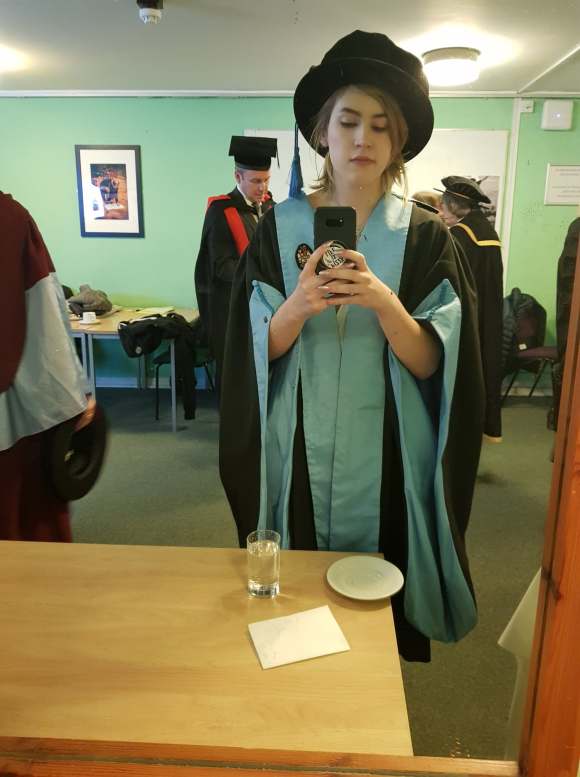
I have a fear of public speaking, but this job is very much orientated around this task. Over the course of graduation, I took part in graduation ceremonies and even gave 20 speeches to the graduates across summer and winter ceremonies. At first, this terrified me because I have dyslexia and reading out loud is one of the biggest challenges due to this. However, with the help of their Learning and Development coordinator’s coaching and online resources, public speaking became easier.
I suffer from Borderline Personality Disorder (BPD) therefore made work difficult at first because students would say negative things about me and the team. To help manage the emotions around this negativity, I kept in contact with HR and the NHS Mental Health to come up with strategies to help cope at work. With support, I drew up a crisis sheet in case I have a crisis during my term as VP Ed & Dem.
Getting approval from the university regarding certain projects was originally difficult. I am a very resilient person, but I needed to develop the skills to know when the perfect opportunities are to get staff onboard a project as well as analysing stake holders to ensure projects can be delivered on. Nevertheless, working with my volunteer officers helped to better justify my plans to the university by collecting feedback I could use to lobby for change.
How Skills Ready Am I?
Whilst undertaking my placement, I regularly use a wide range of different skills because my job is very varied depending on who I interact with and the context in which I must apply my skills. When I started the job, I knew I would be using a wide range of skills, but I did not know what I would be using specifically.
I constantly apply problem solving, research and evaluation skills to my job as I have year projects that I create, plan and implement. Whilst a few of these projects have been complete and evaluated, the major projects require getting stakeholders on board. Thus far, I have overcome the obstacle of getting the harder stakeholders on board and to help with my project delivery, but still have those high up in the institution putting situations in the way. However, I refuse to give up and have researched, networked and found different alternatives to the problems raised to work with the challenging stakeholders to move the project forward.
The biggest development would be my public speaking as I have undertaken the public speaking and confidence courses. Further to this, I have had several opportunities to practice public speaking – from multiple graduations, open day presentations, welcome talks, conferences and presenting to the university which has become easier each time I have undertaken this task. Of course, there is always room for improvements and public speaking is no exception. I will continue to develop this skill throughout my life and ensuring that my dyslexia is not a barrier when reading out loud or presenting. I must continue to take my time when speaking instead of rushing my words because I get my words muddled up, thus making my communication less effective and adds to my anxiety. Misreading words will happen from time to time but slowing down my pace will greatly improve my confidence and help my brain process whilst speaking.
I have also developed project management skills through running my own projects, being a part of university committees with my own part to play in them and undertaking a project management course that SUSU provide. From this scheme, I was able to refine my problem-solving skills, money and financial skills, time management, research and implementation. This has been a valuable learning experience to highlight that I already used some of the skills outside project management and to exercise these skills within the context of a project case. When focused on a project, this has allowed skills to work simultaneously and strengthen the relationship between my skills too.
For further development, I wish to further the skills I already highlighted and strengthening my managerial development with the hope of being an effective and timely communicator that shall serve me well in my professional life.
My behaviour have changed dramatically since starting my placement as I am much more equipped with giving and receiving criticism. I thought I would find this placement hard because I am a public figure and suffer with a lot of mental health issues. However, I have found that through constant learning and development programmes that SUSU provide, I have learnt to separate my personal life from my professional life. By learning this skill, I know not to take things personally and to really listen on how to improve myself from what is said. Furthermore, I have learnt how to give constructive criticism to others by rationalising that if I do not give feedback, I am denying my peer a chance to develop and or denying them help. I do still have to overcome my thinking behaviour such as ‘I am going to hurt them’ by giving them criticism, but it is becoming easier by using the rationalisation I have previously mentioned.
Look Into My Crystal Ball to See My Future (I Hope)
Before starting my placement, I knew what sector I was interested in but did not undertake my placement in this field. I would like to go into journalism after graduation and I plan on applying for an MA in Journalism at Cardiff or Bournemouth University. Although my current job is not related to my future career path, my Year in Employment has been very valuable because being the VP Education and Democracy has cemented my love for education, learning about the sector and looking for innovative products/research from Higher Education. Although I have a passion for writing about music, fashion and sustainability, my Year in Employment has made me aware that I should not be so ridged on what I write about. Due to my placement year, I have now started my own blog to write about my experience as a sabbatical and the Higher Education sector because I have so much knowledge of this, I should formulate and refine my writing skills.
The skills, attributes and behaviours that are required for journalism include:
Enthusiasm
Resilience
Determination
Confidence
Time management
Oral and written communication skills
Interpersonal skills
Research
Tactical
Organisational skills
Integrity
These skills have been harnessed throughout my Year in Employment but developed in a different context to the sector I wish to go into. Furthermore, I will need to gain a National Council for the Training of Journalists (NCTJ) qualification to be a journalist, but this will be covered in my MA.
Throughout the Year in Employment at SUSU, we were offered 360 Reviews, three times throughout our term to help with developing our skills which are rated out of 5. They are at set times of the year and we receive feedback from academic staff, SUSU staff and the relevant student officers. They give feedback on areas such as my job knowledge, stakeholders understanding, volunteer leadership and development, interpersonal skills, communication and self-development.
Though there are overlaps with skills already listed for the future career I wish to work in, my current job is very strategic based and focuses on the student experience at university. I am the head of the educational concerns and responsible for lobbying the university for change in this part of university life which I will not be in the future. However, my current role emphasises collecting data and the importance of being factually accurate, therefore preparing me for the future. I am not 100% sure of what I wish to specialise my writing in, but I would be interested in the Higher Education sector.
Final EvaluationsandAdvice
There have been five of the high points of my employment of course and include, but not limited to:
Securing £10,000 for Humanities students to use to get extra books for their courses as there are often not enough copies of core texts for students.
Getting the university to publish their expenditure in an accessible, clear and transparent way so students can understand where money goes.
Finally breaking through with lecture recordings (Panopto) to be rolled out university wide after 10 years of backlash.
Implementing constant celebrations of the SUSU reps throughout the month
Tackle issues surrounding SUSU Spring Elections which were big issues last year. I have dramatically reduced the amount of complaints this year
Raise our NSS scores to 52% with the help of all of the student volunteers and SUSU staff!
If I were to redo this year in employment, I would take good practice from my colleague and make a year plan from the start so I know when and where campaigns/events/when to implement my sabbatical plan to ensure I have the greatest impact in the short time I am in office for. Although I have developed my Outlook skills, this software does not account for the visualization of vast information I need to know in a glance. Furthermore, if I had done this at the start of the year, this visual planning would help with my dyslexia and lessen the stress of feeling out of control.
I would also spend longer reading the handover documents from my predecessor and getting to know the by-laws they have in SUSU. By getting to know the by-laws, I would then have the confidence in myself to answer people and effectively point people in the right direction when they have questions or ask for guidance. Further to this, the handover document would allow me to understand all the context to projects my predecessor has contributed to therefore I would be able to contribute effectively instead of being timid to take part in university meetings. However, part of the reason why I did not fully understand the documents is the sheer volume of text I had been given, so I will be keeping my handover document short for my successor because a lot of the job is trial and error.
Before my placement, I would have considered myself a very shy person. I suffer with anxiety and depression, which was severe before starting my role and made my shyness worse. Although I still have these mental health conditions still, the support SUSU has provided me with useful information and tips on how to deal with them when they flare up. Having a team of diverse people has also helped in advising me on ways to cope when flare ups happen as well as ways to work on being confident. The biggest and most helpful trick the team has taught me is ‘fake it until you make it’ which means only I know I am the terrified one in a room. If I fake confidence, nobody will know unless I tell others so.
Although I was told that some people thought I would be an incompetent Vice President, I harnessed the emotions I felt about that to motivate myself to ensure I made a lasting impact. If you are ever doubted, remember why you applied in the first place and channel those emotions for good. You will make a difference if you have your heart in the right place and you will develop your skills as you go on – that is natural. Do not compare yourself to others because it is your own journey and not a race.
It has been a pleasure to work with so many different people and I would not have changed it for the world. Ensure you seize every opportunity because you never know what good can come from it.

 A Journey to the Centre of Me